Why Running a Business Feels Harder Now (And What You Can Do About It)
17 Jul, 2025
5 Mins Read


Between 2020 and 2022, the message was loud and clear: if your business wasn’t online, you didn’t exist. Everyone scrambled to build a website, open an Instagram account, list themselves on Google, and try basic digital marketing. For many local businesses this shift helped them survive.
But 2024 brought in something new. This time, it's not about simply being online. It’s about being found the way customers now search and that is changing rapidly.
Free AI tools like ChatGPT, Gemini, and Claude have already changed how people think, work, and decide. ChatGPT receives over 400 million weekly visits as of February 2025, which is 4X higher than its weekly traffic in November 2023. People are now using these tools not just for fun or research, but to make purchase decisions, plan visits, and explore services. And this behavior is reshaping how search works, especially on Google.
So the real question now is: is your business showing up where AI is looking?
Until recently, Google worked like a giant list. You typed in a few keywords, and it gave you ten links. Businesses that had the right SEO tweaks usually showed up first.
Now, Google has released AI Mode and Deep Search features where users ask a full question, and Google answers directly with a neatly summarized block. No more ten links to browse. It’s one answer, powered by AI, with only a handful of businesses making the cut.
Instead of typing "dentist near me," people now type:
Below is a real-time example of one of our clients appearing in a Google AI-generated summary:
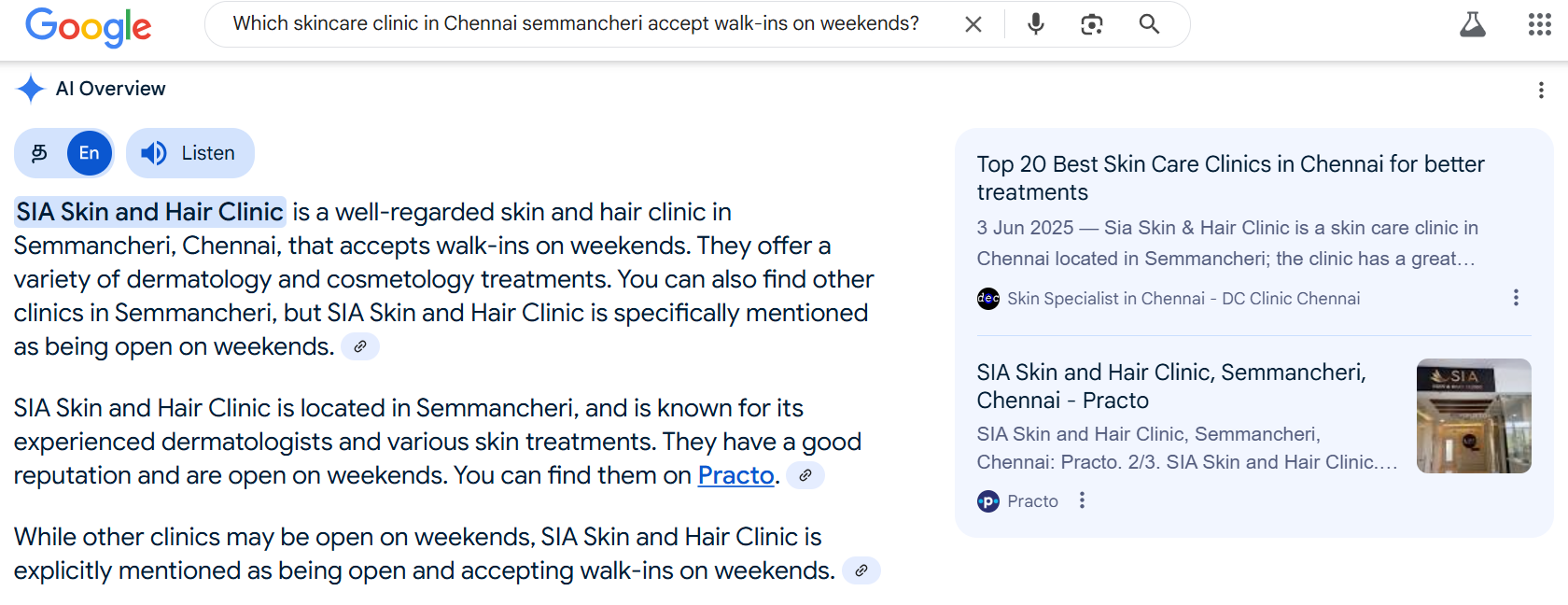
Google responds with a direct summary, often based on Google Business listings, websites, directories, and social media content. If your information isn’t clear, structured, and present across these platforms, you don’t even appear in the answer block.
This is no longer optional, this is where decisions are being made.
Search engines today are being trained by AI models that use your business’s public information to generate answers. This includes:
If a user asks, “Does this clinic treat kids and accept cashless insurance?”, and your website or listing doesn’t clearly say so, AI won’t guess it will simply leave you out.
This is why you must ensure your business profile contains:
If you’re not sure where to start, the fastest way is to create a demo website that mirrors what Google AI is likely to pull into its summaries. ProManage offers such templates, ready to fill in based on your preferences, and aligned with the way modern search works.
Searchers who click from AI summaries aren’t guessing, they’re already informed. And users coming from these AI summaries tend to engage longer and convert faster.
Here’s why:
This means that even if traffic is lower than older SEO days, the leads you get are more ready to act.
But again this depends on whether your business shows up in the summary at all.
You don’t need to overhaul your entire marketing. But you do need to fix the following, right away:
We can help you get started with a free demo website setup. If you’re convinced with out demo website, you can proceed with selecting 30+ industry specific website templates to build the right content for your business.
The AI shift is not something you need to fear. But it is something you must prepare for. Just like post-COVID taught businesses the importance of being online, this next phase shows the importance for small businesses to be AI-search ready.
Start with a demo website that’s built to perform for AI searches. Our team will help you set up your entire online business profile to perform in AI-searches and improve your online visibility. If you’d like immediate assistance talk to our expert here.
Delivering Digital Growth at Scale, for Your Business.

.png)